Saturday, May 29, 2010

New Hampshire and Boston

Grove Street, Peterborough, New Hampshire. In 1938 Thornton Wilder wrote the play “Our Town” based on this town and others nearby. Good food and drink at Harlow’s Pub!


Twelve Pine Cafe, Peterborough. I was drawn to this scene by the collection of pitchers above the window. The view out the window is just behind the pub in the last drawing.


This is the side garden with wisteria vines and a small portion of the wonderful rock garden at the Fells Historic Estate in Newbury, New Hampshire. This was the summer home of John Hay, private secretary to Abraham Lincoln, Ambassador to Great Britain, and Secretary of State to Presidents McKinley and Theodore Roosevelt.


Another nearby garden, this one is behind the Tracy Memorial Library here in New London. This is my third attempt to draw the beautiful but complex fountain by Dimitri Gerakaris. The lilacs are still in bloom.


The green at Dartmouth College, Hanover, New Hampshire. It was finals week, and multitudes of students were studying, chatting, and sunning themselves.


A bronze statue of John Harvard, founder of Harvard College, located in Harvard Yard, Cambridge, Massachusetts. Students touch his toe for good luck, so it is all shiny and polished. The original home of John Harvard is still standing in Stratford Upon Avon, England.


The home of famed silversmith and patriot Paul Revere in Boston, Massachusetts. A rare North American example of an urban wooden structure, built 1680. It was restored in 1906.

This part of Boston is called the North End, and it is now the Italian section, full of wonderful restaurants and pastry shops. The street is cobble-stoned.


Old gravestones at Copps Hill Burying Ground, North End, Boston. There is fashion in everything, including mortuary art. The oldest slate stones have skulls and crossbones, then comes the skulls with wings. Then after 1800, the urn and willow, and the obelisque in white marble were popular. The slate have weathered far better than the marble. My paternal grandfather, Aimé Lapierre, was a stonecutter born in Quebec Province. I come by my love of stones and design through him.


A grouping of fiddleheads, the immature tops of edible ferns. They are ready for cooking for supper. A little garlic and butter in the pan will be all they need. I read that most of them come from Nova Scotia. Our wooded yard here is full of ferns, but they are the inedible variety. I found that out the hard way.


I just wanted to end this post on a very colorful note, so I drew my radishes. These radishes and the fiddleheads are both on sushi plates (slumped glass) I made in a class I took at the Columbia Art Center, Columbia, Maryland.

Sunday, May 9, 2010

Edmonton, Baltimore, and New London


Three versions of springtime!


It’s not a visit to Canada without a trip to Tim Hortons, a chain coffee and donut shop and restaurant. Here I am about to have a maple pecan braid.
It’s not a visit to Canada without maple!


We try to go to the Muttart Conservatory in Edmonton at least once a year. The building has three pyramids: one tropical, one temperate, and one desert zone. And one more of seasonally changing exhibits. We brought our 2 granddaughters this time. We lingered and they drew pictures of the plants.


Here is a drawing made at the Muttart by granddaughter Noelle, age 6. Her mama was happy to see that they share an interest in Mexican type pottery.


Another way to get a rush on spring in Canada is to visit garden centers. Here is our 2 year old grandson having fun in a fountain. He got very wet, and of course, didn’t want to go home.


We took all 3 grandchildren to the Alberta Gallery of Art one Sunday. Here they are enjoying themselves in a room full of soft but sturdy building blocks.


Waverly Farmers’ Market, Baltimore, Maryland. We bought lunch, and fixings for supper. I am drawn to colorful row houses. They are probably 120 years old, and made of porous brick that was meant to be covered with a protective layer of paint.


Broadway, Fell’s Point, Baltimore. One of the oldest parts of the city, once an area of shipbuilding. There are still boats and water activities there, as well as bars, shops, and restaurants.


Rawlings Conservatory and Botanic Gardens, Baltimore, 1881. Such a graceful,delicate looking building. It is near the zoo, and sits on a curve of the street. It always takes me by surprise, like a woman in a ball gown.


Four doorways in a row, on East Baltimore Street, Baltimore. The building material is rough cut limestone and marble steps. All the houses near Patterson Park are elegant.


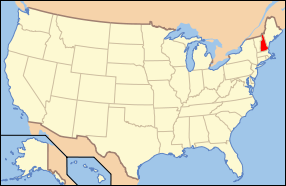
Lilac is the state flower of New Hampshire. And it is lilac season. This scene is the garden behind the Tracy Memorial Library here in New London. The perennials are just popping up. The yellow building is wood frame with a painted wooden siding, recently replaced. Townsfolk devoted a Saturday morning to painting the 10,500 feet of siding before it was installed, saving the town over $7000.


Zoë, Karin and Dan’s cat.

Saturday, April 17, 2010

Massachusetts and Maryland

We have been away from home for a month or so, visiting family in Baltimore and in Edmonton, Alberta, Canada.

I won’t be back till early May, but my husband is now home in New Hampshire and scanned
these drawings from the early part of our trip. Come back in mid-May to see the later ones.


Westford Common, Massachusetts, from the car window. A rainy day.
There was still snow on the ground. We lived in this town for many years when I was in grade school. Yes, that is a small cannon and a pile of cannon balls, Revolutionary War era.


O’Donnell Square, Canton, Baltimore, Maryland
I like the brightly painted buildings on a grey, rainy day. Early spring leaves.


Inner Harbor, Baltimore, Maryland, seen from the top floor of the Barnes & Noble
bookstore in the Power Plant building

Building on stilts is Baltimore’s World Trade Center.


Patterson Park Pagoda, Baltimore, Maryland - 1891
Detail of doorway and cast iron supports


Baltimore skyline from the East
Patterson Park, Baltimore, early Spring
White building on the lower right is an ice skating arena


Twin rowhouses, Patterson Park Avenue, Baltimore
Two grand old brick ladies with ornate wooden cornices.
It had been a hard winter, and the woman weeding the front garden was greatly enjoying herself!


Children’s mosaic, Fairmount Avenue at Luzerne Street, Baltimore
Banner Neighborhood Art Club, 2006


Yellow Man
Eastern Avenue, in the Highlandtown neighborhood of Baltimore
Metal scrap statue by David Friedman

Sunday, April 4, 2010

Running late in April

I'm out of town right now, so the April post will be a bit late. But I've been drawing all the time, so there will be lots to see when you check back around the middle of the month!

Sunday, March 7, 2010

An early spring day

Another March Posting!

A tower at the huge, and now defunct, Amoskeag Mills in Manchester, New Hampshire. Built in 1850 and once the world’s largest cotton mill, it’s now being nicely redeveloped and filled with other tenants. The sign said that this part of the place will soon become a Hilton Hotel.


These town houses or row houses are called, in Manchester parlance, corporations. The Mill built housing in this mid-1800's planned community for its employees and their families from Quebec, Scotland, Greece, Sweden, Poland, and many other places. Eventually, the mill industries moved to the southern states when water power was no longer the sole source of power.


I walked through Manchester up to the Currier Museum of Art. In the courtyard is this sculpture by Mark Di Suvero, entitled “Origins.” The black central part rotates in a slight breeze. I tried to draw it as it turned. I liked it.


The Currier Museum has many treasures. I drew this mural by Sol Le Witt, located in their café. It is called “Wall Drawing #1255, Whirls and Twirls.” This is only my interpretation of it, but the colors and shapes are accurate. You would recognize it if you saw it.


Main Street, New London, New Hampshire. In the background, buildings on the campus of Colby-Sawyer College. In the foreground, a row of very old and weather-scarred sugar maple trees, being tapped for spring sap. A sharp, hollow spike is driven into the bark; then the sap drips into the buckets. The mildly sweet sap is collected, and boiled down into maple syrup. The little peaked roof just keeps out the rain.


The modern method of collecting the sap. The sap from throughout the woods drips into the blue plastic tubing and accumulates in the white container. Sap season (or sugaring) is when the nights are still cold, but the days are warming. It doesn't harm the tree. I could sees the bubbles in the tube, and hear a steady stream of liquid going into the tub. I was practically hallucinating thinking of pancakes or waffles swimming in syrup. It is a health food you know, being full of minerals. You see the well known New England stone wall. That's a whole other topic.

Monday, March 1, 2010

New Hampshire and Maryland

Another search for color in mid-winter. Our table with primrose plant, multicolor pepper, and tabasco sauce. That is not a real cat sitting on the table, but a miniature clay sculpture. I love cats, but not on the table.


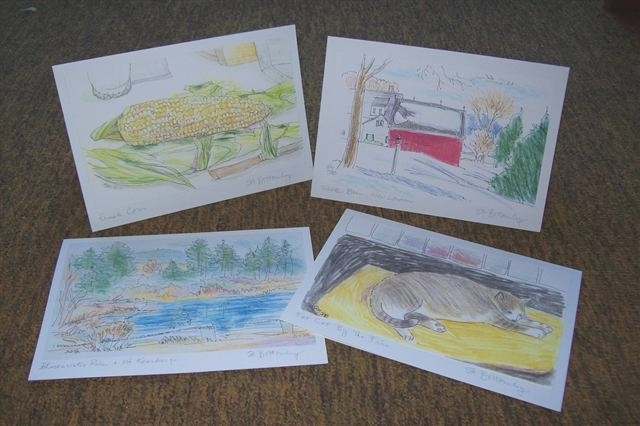
The red barns look even more colorful in the winter. We pass this barn every day. I chose to draw it this day because of the snow pattern on the roof. You can see the mountain and the frozen lake in the distance.


I am fascinated by the variety of architecture in this area of New Hampshire. This brick and granite building, Pillsbury Memorial Hall, was constructed in the village of Sutton Mills in 1891. The interior is lined with beautiful charcoal portraits of village elders, all in place since 1891. It is used as local government offices and community space. Note the small scale of the surrounding buildings in comparison. Yes, its name comes from the family that started the flour company in Minneapolis, Minnesota. Originally from New Hampshire, they have been generous contributors throughout this area.


Sutton is a spread out town, just south of New London. This building is a general store in North Sutton. Notice the community bulletin board to the right of the door. The signs say “Live Bait, Pizza, Kimchee.” General stores, a relic from the horse and carriage era, sell everything imaginable.


The Opera House in nearby Newport, New Hampshire. Another grand edifice, this one built in 1886. We have attended plays and concerts here. There were about ten such Opera Houses built throughout the state at this time for the edification and enjoyment of the mill employees. Our goal is to visit all of them.


This Opera House is in the town of Claremont, west of New London near the Vermont border. The statue in front is from 1869 and commemorates local men who fought in the Civil War.

Thursday, February 4, 2010

Mid-winter mini-posting!

My eye searches out color in mid-winter. I’m sending this mini-posting to all mid-winter people, especially those about to get another huge snow storm. The ground is white here in New Hampshire, but we have escaped blizzards, knock on wood.


A wonderful, sweet smelling, spring smelling, and extremely long lived bouquet of hyacinth blooms, bought in the grocery store, grown in greenhouses in Canada. Thank you, Canada. Again I draw my pitcher, with the hand painted scenes of Tallinn, Estonia.

An assortment of objects on the dining room/painting room table. These include the pitcher and a holiday card from my friend Mary Jo Tydlacka. The setting for her painting (simplified here) is of the Patapsco Female Institute Historic Park in Ellicott City, Maryland. (This is the ruins of a 19th century boarding school for girls. Real studies too, not just ‘finishing.’ I used to work here as a docent.) The play is Cyrano, performed by the Chesapeake Shakespeare Company.

Today I found color in my art supplies. Koh-I-Noor Colored pencils and Pigma Micron pens from Japan. Included is the drawing just described above. Similar to a play within a play.

The view of our ridge from the living room. I tried to draw ‘alpenglow.’ This is when the setting sun in the west shines on a ridge in the east providing a kind of reflected sunset. This golden/pink/green effect only lasts a few minutes and was gone before I finished drawing. The red in the front is our sofa. Its color pleases me too. With a house with so many large windows, some furniture must back up against the glass.