Monday, October 25, 2010

New Hampshire, Connecticut, Michigan, Wisconsin, Vermont, Maine!


We did a bit of traveling this month...we drove from New Hampshire to Wisconsin, where my sister and lots of family live. This is the mid-western branch. Both my sister and her husband are transplanted New Englanders. It was a good trip.


This is our state house in our capital city, Concord, New Hampshire. It was built in 1819 of granite. There are 400 members in the lower house, or one for every 3,000 people in the state. With 24 senators in the upper house, it is the fourth largest legislative body in the world! And the pay is $100 per year. This means no one is a professional politician. (I’ve read this keeps corruption down to about zero.) New Hampshire has a different way of doing things.


During a quick trip down to Hartford, Connecticut, I decided to draw a portion of the house of author Mark Twain. I have visited the interior several times and this day just attempted to draw the ornate facade. I had to move from my first drawing location, after too many large acorns landed on my head.

The style of the house, built in 1881, is Victorian Gothic. It has a slate roof, and bricks of brown, black and red. In the top floor of this house Twain wrote, during 17 years, Tom Sawyer, Huckleberry Finn, The Prince And The Pauper, and four other major works. He and his wife raised their children here. The top floor, indicated by the row of small arched windows, is his billiards room. This was reserved, he said, for writing, male guests, cigars, liquor, and swearing. In 1881, the interior was redone by Louis Comfort Tiffany. In the front hall is the first telephone in Hartford.


The Bluff Walk, St. Joseph, Michigan. In the distance is Lake Michigan, one of the Great Lakes that separate the U.S. from Canada. It is so vast that it has the appearance of an ocean. We discovered this resort town by serendipity, and wandered happily there for hours. The peaked building houses a carousel. The town recently acquired it, as it is restoring its beachfront to again appeal to visitors. We rode on the traditional carved wooden horses. There were other animals too, such as fish, mermaids, otters, tigers, and a praying mantis. You can see a wonderful display of all the animals, accompanied by the actual carousel music, at the Web site of the Silver Beach Carousel Society.
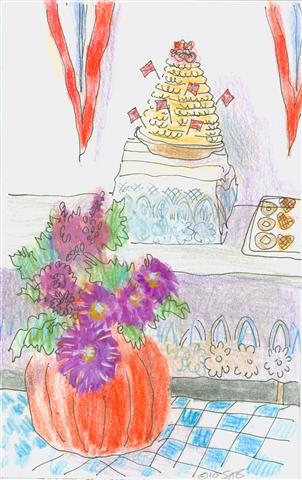

Sons of Norway breakfast in the town where many of our family members live, Mount Horeb, Wisconsin. Many towns in the American mid-west were settled by Scandinavians in the 1800’s and continue their ties and traditions.While we ate our three kinds of pickled fish, waffles, and other delicacies, I drew this view. It shows a small pumpkin hollowed out to form a vase, fall flowers called asters, and on the table behind, a layered cake called ‘kranskake’. I believe this translates to crowncake. The layers are ring shaped and hollow, and made of ground almonds, egg whites and sugar. While sometimes called a Norwegian wedding cake, I read that it is generally made for any festive occasion. It is traditional to stick flags and or flowers and candies all over it.


And here we are on a side street in the town of Mount Horeb, Wisconsin, a few miles west of the capital city of Madison. The yellow brick building with the turrets is the town Opera House, although it is no longer used for that purpose. The tavern on the far left has sign on the window that says ‘better burgers’. I believe this implies that everyone in town knows that the brewpub across the street, the Grumpy Troll, has the best beer and ale. The white bubble shaped object is a water tower.


Doesn’t the Copeland Opera House in Shullsburg, Wisconsin look like a theater set itself? The small town started with lead and zinc mining. Since the ore was very close to the surface, mining is probably not the correct term.

Once a small town got sufficiently prosperous, a theater was usually built and most often called an opera house. Operas may have been on the ticket sometimes, but it was mostly a community venue for stage shows, singing, local talent shows, and any traveling entertainment. Stage set remnants, I guess, are in the windows. It was built in 1882.


Mount Ascutney, Vermont, seen from across the Connecticut River. The river forms the border between Vermont and New Hampshire. This little park is in Cornish, NH. I always want to say ‘hello’ to a mountain when it pops up into sight. To me, a mountains seems a benevolent presence, overseeing our lives. It remembers the past and greets the future with optimism.


This is another view of Mount Ascutney, from the Saint-Gaudens National Historic Site, in Cornish NH. The home is indicated at the left by the stairs. The plants in the foreground are red bee balm and purple aster.

This was the summer home of the famous sculptor Augustus Saint-Gaudens (1848-1907) As well as the home, his studio is here and several outdoor sculptures.(I didn't feel it was respectful to make a sketch of a masterpiece, so I only drew the land.) He designed coins for the U.S. mint, as well as bas relief sculptures, and free standing ones too. His most famous bas-relief stands in Boston Common (Massachusetts) directly in front of the state house. It depicts Col. Robert Gould Shaw and the 54th Massachusetts Volunteer Infantry, one of the few entirely African-American units in the American Civil War, 1861-65. This story is widely known, as it was the subject of the 1989 film Glory starring Matthew Broderick and Morgan Freeman. Here is photo of this sculpture. It has the illusion of 6 figures deep within only about 12 inches (30 cm) of actual depth.


The Augustus Saint-Gaudens bas-relief sculpture on the Boston Common.


French’s Beach at Lake Massasecum, Bradford, NH. The autumn foliage has lasted for weeks. It is about over, but what a glorious show. The green pine trees set off the colors of the maples, oak, birch, and beech trees.


One of my favorite foods ... a lobster roll. (Pronounced locally as ‘lobsta rawl’) This one from Warren’s in Kittery, Maine begged to be drawn. What with large chunks of lobster including claw meat, frilly lettuce, and buttered toasted roll! Combine that with a water view out of the window, great day.

Monday, September 27, 2010

New Hampshire

I was sitting on the tiny wharf at Pleasant Lake, and turned around. This is the view: colorful kayaks, the building on the right called the annex, and the Inn at Pleasant Lake.


At the other end of the small lake is our post office. Here is the view from the parking lot. I don’t have to search out beauty around here, as it surrounds me. The leaves are just starting to turn their fiery autumn colors on Morgan Hill in the background. Our house is in the woods on the lower hillside, approximately where the birch trees cross.


This is Main Street in Newport, two towns over to the west. The middle building with the turret is the old court house, now the location of a nice restaurant. I love to draw red brick buildings. Bricks are an amazing thing to make with the local clay.


This imposing building just a few buildings down the street from the last drawing is called the Eagle Block. It was recently saved from demolition. Once a hotel, it now has a great Irish pub on the ground floor. Both buildings date to 1826.


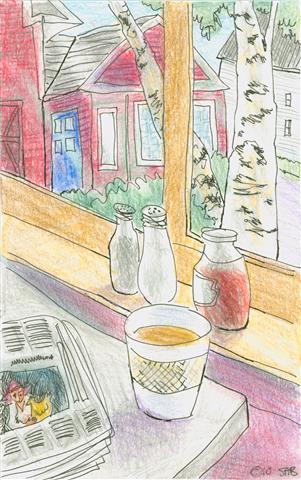
Here we have the view from our coffee shop in New London, called Ellie’s Deli. I love birch trees.


This month the New London Garden Club hosted a flower show with competitions and exhibits, which was held in the Town Hall. The Town Hall is where we vote, and also the site of concerts and lectures. The windows are large and the color of the walls is wonderful. It is a sort of celestial blue.


Some of the vegetable entries.


More vegetable entries.


Some entries in the grasses and shrubs categories.


And there are always many entries for dahlias. I loved how the sun was shining through the petals, with sort of a stained glass effect.

Friday, September 3, 2010

Alberta, Maryland, and New Hampshire

Here are three wonderful children coloring the sign for their upcoming lemonade stand. They happen to be our grandchildren.


I turned the corner and this color combination just smacked me in the eye. It is the red tiles of the Scotia Bank building in Edmonton, Canada. And the yellow brick, lush red roses, and prairie sky.

As I was standing there, I started to muse on the wonderful abilities of plants to adapt to differing climates. How is it that a rose can thrive in cool damp England (where we lived for 3 years), and Maryland (30 years: humid in summer and sometimes cold in winter) to Edmonton which is hot, dry, and cold. I have wondered this same thought in Arizona. One of nature’s miracles.


North Lakewood Avenue in Baltimore, one block north of Patterson Park. All these rowhouses were built by the same builder about 1900. They are brick with marble trim and steps. Our daughter and son-in-law own the house on the corner. The yellow pressed tin is original decor, while the interior and the roof deck are contemporary. There's a great view from the roof!

Their house was once a store for the Catholic school and church across the street. The family lived in the top floor.
Many street corners in Baltimore were occupied by small neighborhood stores. Some still are, and many have become homes, often a bit larger than others on the street.


And here are the next four houses on the street. I have been wanting to draw the blue balcony for quite a while. There are three or four more of these balconies in the block. You have to look at a whole line of rowhouses to understand what the architect had in mind. It is all a repeating pattern, and you can see the original, unifying theme as you look down the street. Sometimes you have to close your eyes and visualize what that theme was intended to be, as parts often have fallen off and were not replaced, replaced poorly, or simply covered up. They all once had dentil molding along the roof lines, for example. I haven’t seen another block with quite like this. Even the houses across the street have a different theme.

The house on the far right is now covered in Formstone. It is a facing made of tinted concrete, and is attached to the bricks. It even covers the marble! The surface is marked with indentations to resemble stones. Done in the 1940s and 50s, it was quite a fashionable thing to do and addressed a not uncommon problem of porous brick.

The hot competition among companies in the trade served as inspiration for Barry Levinson’s 1987 movie Tin Men, though Levinson apparently figured that the aluminum siding wars of the 50s and 60s would have broader appeal and recognition than wars involving something so localized as Formstone.

Many people now remove the Formstone, some with adequate results but many with damage to bricks, marble, and even structure. We ourselves own a corner rowhouse covered in Formstone. We didn’t put it there, but we have no plans to remove it. It’s part of the quirkiness of Baltimore (Bawlmer). It’s even the name of a recently introduced local microbrew ale!


This is Fells Point, at the corner of Broadway and Thames in Baltimore. It is pronounced ‘thames’, not the British ‘temz’.

The sign with the raven is for an outdoor film series. The raven is one of the symbols of Baltimore, because the short story writer and poet Edgar Allen Poe lived and worked here, and died here. The Ravens is the city’s football team.

The buildings are being gutted and rebuilt to become part of the lovely Admiral Fell Inn across the street.


Here we have a view of the same corner buildings, looking in the other direction. I drew from the corner door of the Admiral Fell Inn, under the shade of the turquoise umbrella. It was a very warm day, actually too warm to be out sitting at the sidewalk cafe. I believe the large brick building in the background was a customs house. The man on the canvas flag is probably Admiral Fell.


I bought this bouquet at the New London Garden Club antique show. The container is an old and dented pewter sugar bowl.


Many times I think about what I will draw in advance. Other times I drive past, look, slam on the brakes, hop out, and draw on the fly. This is because I feel that whatever it is I am attracted to will soon disappear.

This wooden object seems to be a sled or sleigh, for snow or ice. It seats two people.
Our neighbors who run the inn at the bottom of the hill were cleaning out their barn, and I saw this in their yard. There may well be one of these in everyone’s barn. I was struck by how soon the familiar becomes the mysterious. I need to talk to an older generation.


This very old, twisted apple tree produces both yellow apples and red ones. I like its gnarled shape suggesting advanced age—but the abundance of fruit!


I call this drawing ‘A Peek At The Peak’. Our town’s main street (Main Street) follows along a mountain ridge. You glimpse hazy-blue mountains on all sides as you drive or walk down the street. I love having a vista and miss it when I am not here. This is Mount Sunapee, which has ski trails on it and a resort.

Wednesday, July 21, 2010

New Hampshire, Vermont, and Quebec


Here is the New London Market on the Green, with musicians in the bandstand. (Actually there was one official musician, and she cleverly enlisted kids from the audience to provide the accompaniment, mostly percussion!) The green, also known as Sargent Common, is a large open space in the center of town on Main Street. It is used for fairs and festivals, as well as kids and dogs running around.


The Town Green at a Friday night concert. The building on the far left is the town offices, on the far right the Whipple Town Hall. Click the picture (or any of the pictures) to make it bigger...there’s lots of detail in this one!
The dog in the front is our Shih-tzu Hank. Children love to come and pat him. One group told us that their objective for the evening was to pat every dog there!


Across the street from the green is this large yellow wooden building. A former pharmacy, it now houses several small businesses including the local sports shop, selling and renting kayaks as well as bicycles and other equipment. Recreational kayaks are very popular in our area. They have a wide, flat bottom, are easy to paddle, and are very stable.


My feet, in my Oldtown Otter kayak. The lake loon family is off to the right, and Mount Kearsarge is in the background. This is the first time I’ve sketched while in the kayak.


This bouquet is composed of Pick Your Own flowers from Spring Ledge Farm in downtown New London.
Our middle of the room fireplace is in the rear with its mesh metal curtains.


We stopped to check the map on our way home from Burlington, Vermont. I loved the shape of the mountain in the distance, named Camel’s Hump. You can even see it from New York, on the other side of Lake Champlain.


Vernacular architecture fascinates me. This style is common in the province of Quebec. The owner of this house came out to greet me—and ask me what I was doing in his field. He proudly told me the house was three hundred years old. It is located in the village of St. Ferriol des Neiges, a few miles east of La Ville de Québec. The roof is now seamed metal, but maybe it was slate originally. The woodwork around the door and windows is ornately decorated and looks appropriately old. The surface is stucco, probably over field stone. We saw many similar houses constructed of stone without the stucco. I can envision my Québecois ancestors living in a home like this.

The Québecois are a proud, hardy people, with a genuine joie de vivre. They have maintained their culture and language for going on four centuries in this North American outpost, so far from France. I'm proud to have some of their blood flowing in my veins. Along with the Anglo-Saxon stuff, and a few drops of Native American too.


This present day Basilica of Sainte Anne de Beaupré was built in 1926 to replace one lost by fire. It is enormous. I tried to convey that in my drawing by allowing myself to get totally lost in the details of the grey stone façade. You can sense the scale by comparing the building to the size of the people on the stairways. I made a little inset drawing to show the overall shape. The word “accueil” means welcome, and the Quebec Province flag is flying proudly at the Welcome Center. Everyone we met in Quebec was kind and patient, and usually pretty good with English (or French French!). I got a minimum of sketches done because I was feeling unwell and therefore lacked powers of concentration. Next time.


I like this sign at a farm stand near Claremont, NH. Of course it changes from one week to another.

Sunday, June 20, 2010

Florida, New Hampshire, and Maine

We spent 4 days in Clearwater Beach, Florida the first week of June. It’s on a barrier island facing out toward the Gulf of Mexico, west of Tampa. One of the things I like best about traveling is the differences in plants and animals. This is the patio outside our rental condo. Note the tiny gecko. They came out of hiding every evening.


The small pool is next to the patio, looking back toward the mainland. Every morning there was a different bird standing in the shallow water at the edge, getting a drink. Here are a laughing gull and a blue heron, who were not actually there at the same time.


Friends took us out to lunch at Tarpon Springs, the natural sponge capital of the world. The sponges are harvested by divers. Most of the divers and their families came from Greece originally. This means the small town of Tarpon Springs is full of wonderful restaurants. I bought these sponges while the others were finishing up their lunch.


Here's an old post card of the Tarpon Springs sponge exchange, dated 1940.


This is a Concord Coach, a deluxe type of carriage designed and made in Concord, New Hampshire, and used throughout the world. The lettering at the top says New London and Potter Place. This one currently resides at the New London Historical Society, but I drew it as if it were outdoors making the journey between New London and Potter Place, the end of the rail line. It carried residents, tourists, and students. I like how the iron rods are all bent on the roof....the result of lots of heavy trunks. Also, look how tiny the steps are to get into the coach, and the last one was was a huge heave up into the inside. Picture that with layers of petticoats and hoop skirts.


And a photo of the Concord Coach stopping in Elkins, a part of our town of New London. I believe this store was located at the end of the lake near the dam. The suspension system of the coach involved leather straps, rather than metal springs. So it rocked rather than bounced. Mark Twain called the Concord Coach a ‘cradle on wheels.’


Potter Place Railroad Station in the town of Andover, five miles from New London. In the 1800s, you could get this far by train from Boston in four hours. On the upper right of the drawing, I made an enlargement of the wooden roof trim. As I was observing it closely, I realized it was meant to look like ivy, not icicles. An aha moment.

Potter Place is the name of the large estate of Richard Potter (1783-1835). He was born in Boston and lived in Portsmouth and nearby Hopkinton. Educated in Europe, he returned to become America’s first magician, hypnotist, and traveling showman. And he garnered a good deal of wealth with his stage shows. There are several accounts of his life online, and his illusions are still remembered and described. I have never seen the word ventriloquist on a gravestone before! It and that of his wife Sally are directly behind the no longer used station.


This is an inlet on the Kennebunk River in Kennebunkport, Maine, at low tide. I like the faded colors, and the jumble of roof angles, wooden piles, and deck railings. Most of these old fishing related buildings are now restaurants and shops.


Here is my close up drawing of a sea captain’s house from the early 1800s in Kennebunkport, Maine. The door is framed by elegant curved glass panels. Next to the windows are black shutters. The house is wood frame with painted grey wooden clapboards. A home like this would be made of stone in many parts of the world. In New England, wood was plentiful. We are lucky they survive.


These flowers are in my kitchen on the counter. Behind them is a a very small watermelon. I added wildflowers to the vase after a walk. The vase is really a drinking glass with an image of Venice on it.